


Buying guide
Start with the missing supplier reply
An overdue confirmation is a useful place to begin. Define what the agent may read, what it can draft and which decisions stay with the buyer.
Read the articleDecision brief
Use a work order, an old procedure and an absent operator to see what the agent does when the easy part is over.
Read the articleBuying guide
An overdue confirmation is a useful place to begin. Define what the agent may read, what it can draft and which decisions stay with the buyer.
Read the articleImplementation plan
Agree the pass conditions, rehearse a failed update and leave the team a procedure it can use without the original builder.
Read the articleFrom the archive
Seven enterprise AI solutions assessed for manufacturing operations, from supplier follow up and order handling to plant knowledge and aftersales support, with the criteria, a buyer's guide and a shortlist checklist.
Read the articleBest for: An operations team that will own the procedure and accept the result, with help to build it.
If your buyer or planner knows the job but needs someone to build the agent, start with Nexus. Its engineer-led offer is relevant to that gap; ask to see it handle the plant’s own procedure.1,2
A required system action, hosting boundary or support period is still unanswered.
Best for: Automation teams joining software robots, applications and human decisions in an existing process.
UiPath is a strong alternative when a plant already uses software robots and needs work to pause for a document or a person’s decision. Its platform explicitly connects those steps with agents.3,4,5
The chosen deployment has not shown the required agents, connections and recovery steps working together.
Best for: A Microsoft-centered plant with assigned builders and a way to approve releases.
Copilot Studio deserves a look when plant IT already manages Microsoft environments and has people ready to build and release agents. Its policies and release tools can fit that team’s existing work.6,7,8
You are treating a knowledge answer as proof of an allowed ERP update, or a license as a promise to do the build.
Full comparison
Choose which providers to keep, then focus the evidence on one buying criterion.
Choose at least one provider to compare.
If your buyer or planner knows the job but needs someone to build the agent, start with Nexus. Its engineer-led offer is relevant to that gap; ask to see it handle the plant’s own procedure.1,2
Nexus says an engineer builds the first procedure alongside your team and shows it running in your own tools.1
Nexus lists connections to ERP and CRM systems, communications tools and custom APIs. It says information can pass in both directions.9,10
Nexus says uncertain cases go to a person with the relevant context.11
Nexus describes access by role and records of actions and decisions. Its blog says data flow, access and audit trails need sign-off before launch.12,13
Nexus says it builds with the customer’s team and stays to improve the first version.1,2
Copilot Studio deserves a look when plant IT already manages Microsoft environments and has people ready to build and release agents. Its policies and release tools can fit that team’s existing work.6,7,8
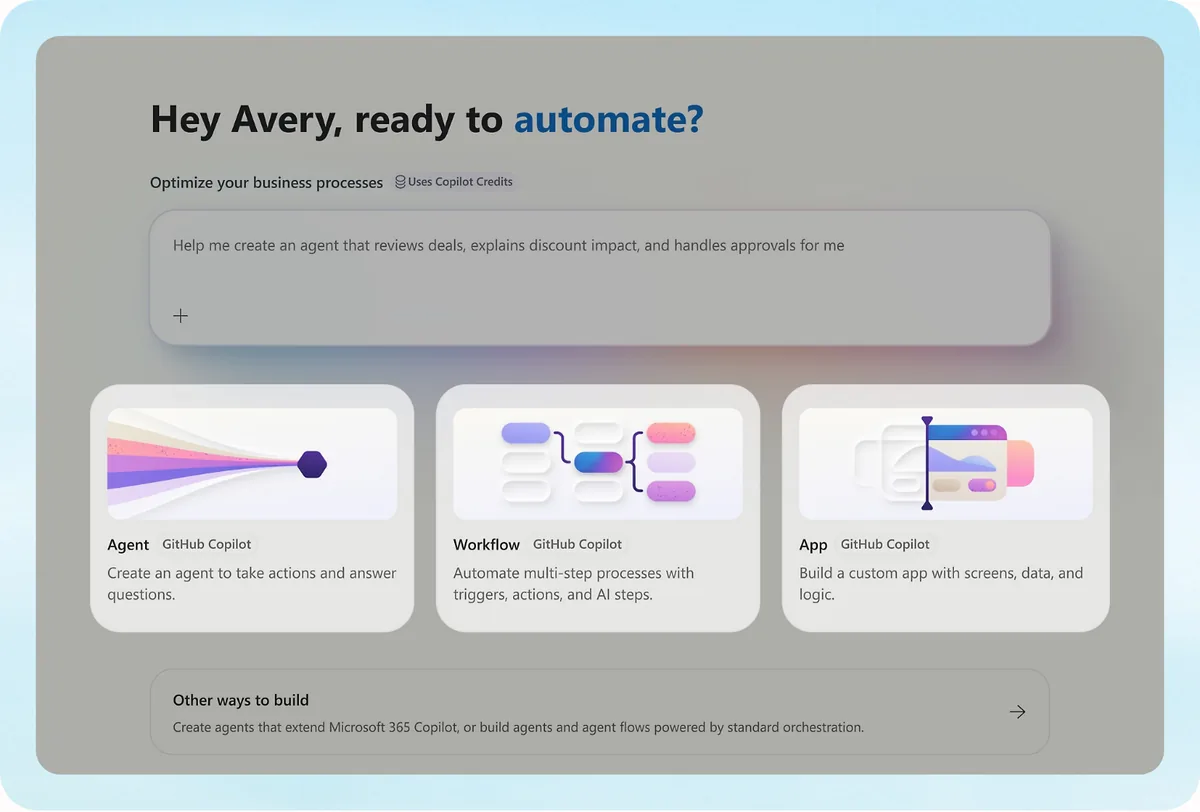
Microsoft says makers can describe an agent in ordinary language and test it before publishing.14
Microsoft lists Power Platform, Dynamics 365 and external knowledge sources, alongside prebuilt connectors and MCP servers.8,15
Can the agent save unfinished work and hand it over when a system fails or the shift changes?
Microsoft documents administrator data policies, knowledge access tied to the signed-in user and approval gates for moving agents into production.6,16,7
Microsoft provides tools to build and test agents, with controls for moving them through development, test and production.14,7
Gemini Enterprise is worth considering when the plant’s information already lives in Google Cloud projects or BigQuery. Its search and data connections give that team a place to start.17,18
Google describes search that respects permissions and a workbench for building agents without code. It also offers a Frontline edition for frontline workers.17,19,20
Google documents a federated BigQuery connector. It says data stays in place when Data Cloud connectors use federated mode.18,21
Where does the agent record a failed query, conflicting information or a task waiting for the next shift?
Google documents Cloud IAM and document-level access controls. Its Agent Platform documentation describes tool-use rules written in plain language.22,23,24
Google documents buying a subscription, then distributing its licenses across projects and locations. Standard and Plus customers can publish their own agents.25,26,27
UiPath is a strong alternative when a plant already uses software robots and needs work to pause for a document or a person’s decision. Its platform explicitly connects those steps with agents.3,4,5
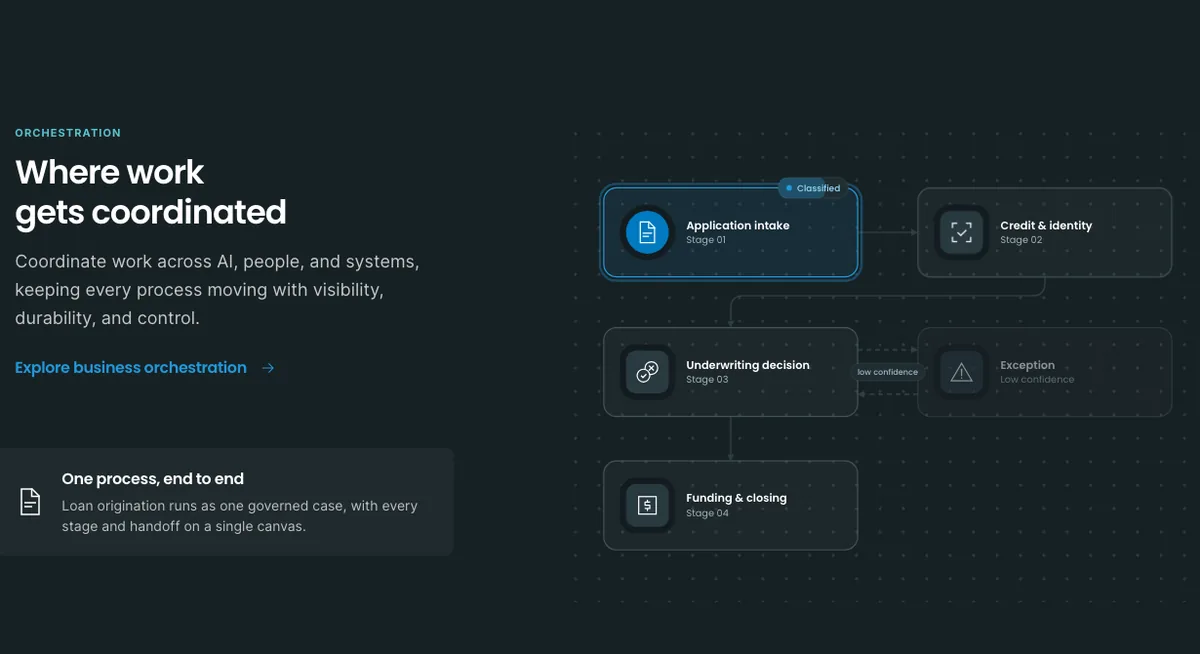
UiPath describes a platform joining AI, people and systems: agents reason, software robots act and people make decisions where needed.3,4
UiPath’s Integration Service includes prebuilt connectors and a Connector Builder.28
UiPath says a process can wait for documents or approval and then resume. Low-confidence decisions can go to a person with their context.5,29
UiPath describes pauses for approval and tamper-evident logs recording actions, tool calls and human approvers.5,30
UiPath offers code-first and low-code development. Its pricing material describes self-hosted installation, including air-gapped deployment.31,32
Workato is a strong candidate when an integration team wants events in business systems to start and coordinate work. Its triggers and reusable recipes suit that approach.33,34,35
Workato says its Genies can start from business events, schedules or APIs, and use reusable recipes and skills.33,34
Workato describes ERP and database connections, with a gateway or On-Prem Agent for reaching on-premises applications.35,36,37
Workato documents audit logs for workflow runs, configuration changes and user actions.38
Workato describes human approvals, detailed access controls and roles deciding who can create, build and deploy workflows and agents.39,40
Workato offers onboarding and training packages. Standard includes development, test and production environments.41,42
Glean deserves attention when maintenance or engineering staff struggle to find the right information across tools. Its search and source-permission model fit that first job.43,44,45
Glean describes enterprise search and bringing engineering code, tickets, documents and incident history together.43,45
Glean offers an Indexing SDK for custom data and OpenAPI definitions for custom actions.46,47
Glean describes requiring approval before an agent acts and sending audit events to a security monitoring system, or SIEM.48,49
Glean says source-system permissions apply to reads and writes. The security material checked November 8 marked agent policies and separate agent or user policies as coming soon.44,50,51
Who owns source permissions, connector setup, current content and ongoing support in Glean’s proposal?
Relevance AI is worth considering if the first project should teach your operations team to build and supervise later agents. It describes workflow mapping, an embedded team and training.52,53
Relevance AI says it helps customers map workflows and identify suitable agent use cases.53
Relevance AI says schedules, application events, webhooks and custom signals can start an agent.54
Relevance AI lists conditional approval rules and ways to pass cases on through email and Slack.55,56
Relevance AI describes approvals for individual tools, customer-set thresholds for human sign-off and rerunning evaluations before publishing changes.57,58,59
Relevance AI describes an embedded team that gets the customer live and then trains the customer’s staff.52
Your plant already uses software robots, and the process needs to wait for documents or decisions.
Put UiPath near the top of that evaluation. It describes agents, software robots and people working in one process, with pauses and resumptions around approvals.3,4,5
Trade-off: Name who maintains each robot and connection, then show how the chosen installation recovers from a failure. The engineering work still needs an owner.31,28
Plant IT already manages Microsoft environments, data policies and releases.
Copilot Studio may fit that team well. Its documented data policies and release approvals give colleagues controls within the environment they already manage.6,7
Trade-off: Give the builders time and check every plant connection. Access to Dynamics knowledge does not prove the action needed in another ERP or maintenance system.14,8,15
A maintenance colleague needs the current approved procedure or a relevant incident record.
Give Glean an early trial. Its search respects source permissions, and its engineering proposition brings documents, tickets and incident history together.43,44,45
Trade-off: Decide who owns each document and how the correct revision is selected. Permission to read a procedure does not show that it is current for this machine.44
Your integration team maintains recipes and wants business events to start work across systems.
Workato is a direct candidate. Its event, schedule and API triggers and reusable recipes fit that approach.33,34
Trade-off: Follow the entire network and data path. Workato’s On-Prem Agent reaches private systems; that does not mean all of Workato runs inside the plant.37


